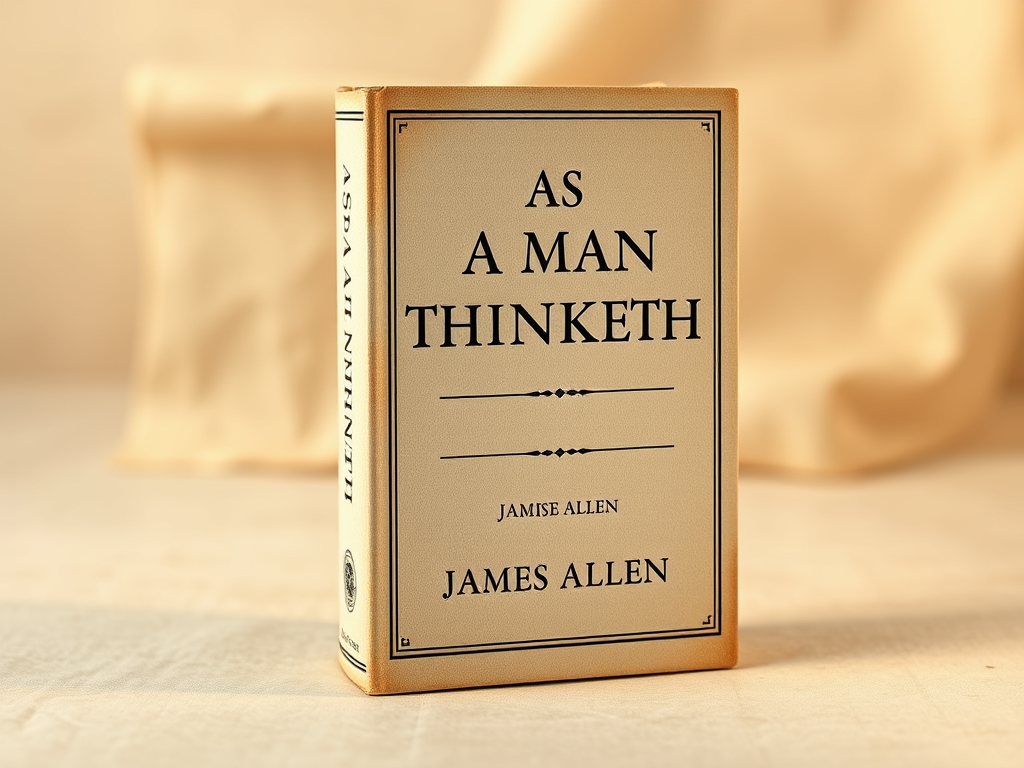
A Book of Philosophy where East meets West
In 1903, British philosopher James Allen published a little book titled As a Man Thinketh. Barely 45 minutes to read, it’s remained in print for over a century, and for good reason. It’s deceptively simple, but deeply profound, and its power lies in its ability to quietly blend Eastern wisdom and Western scripture into a unified philosophy of inner mastery.
At first glance, the title itself gives away two key truths:
1. It alludes to the Bible: “As he thinketh in his heart, so is he” (Proverbs 23:7).
2. It suggests the shaping power of thought, that what we dwell on internally becomes the form our life takes externally.
Both of these are true. But Allen goes much further than most casual readers realize.
Mind as the Creative Force.
In the very first pages, Allen includes a short but powerful poem that lays out his entire philosophy:
“Mind is the Master power that molds and makes,
And Man is Mind, and evermore he takes
The tool of Thought, and, shaping what he wills,
Brings forth a thousand joys, a thousand ills:—
He thinks in secret, and it comes to pass:
Environment is but his looking-glass.”
This is where the Eastern voice enters the room.
In the Upanishads, ancient Hindu texts from thousands of years earlier, we find a remarkably similar teaching:
“As a man is, so he sees.”
In both teachings, the outer world reflects the inner. We don’t see the world as it is; we see it as we are. Allen rephrases this ancient wisdom in the psychological and moral terms familiar to Western readers. But the root philosophy is the same.
The Western Path to Eastern Insight
Allen, a Christian mystic and philosopher, doesn’t name the Upanishads. He doesn’t quote the Buddha or Laozi. But he doesn’t need to. His ideas breathe in the same rhythm.
The Biblical phrasing anchors the text in moral and spiritual tradition familiar to Western readers.
The Eastern philosophy gives the book its metaphysical depth: karma, causality, and the power of sustained inner practice.
Most people expect this book to be motivational. They don’t expect it to be a manual for spiritual development. And yet, that’s exactly what it is. Allen quietly asks us to take full responsibility for the conditions of our life, not to blame ourselves, but to recognize our creative power.
A 45-Minute Read that Takes a Lifetime to Practice
As a Man Thinketh may be short, but its cultivation takes time. Allen speaks in plain language, yet what he describes is the same ancient path walked by yogis, sages, Stoics, and saints:
Watch your thoughts.
Shape your inner world.
And your outer life will change.
This isn’t just a self-help book. It is a bridge between two worlds, East and West, ancient and modern, spiritual and psychological.
A Mirror for the Soul
If you’re looking for a book that blends Eastern and Western, start here. Allen’s little book is a treasure, one that, if read with openness and reflection, will reflect back to you not just who you are, but who you might become.
As Allen reminds us:
“Environment is but his looking glass.”
The world around us isn’t separate from us. It is shaped by the thoughts we plant, water, and live by.
And that is an idea both East and West can agree on.
Discover more from The Silent Philosopher
Subscribe to get the latest posts sent to your email.
 The Silent Philosopher