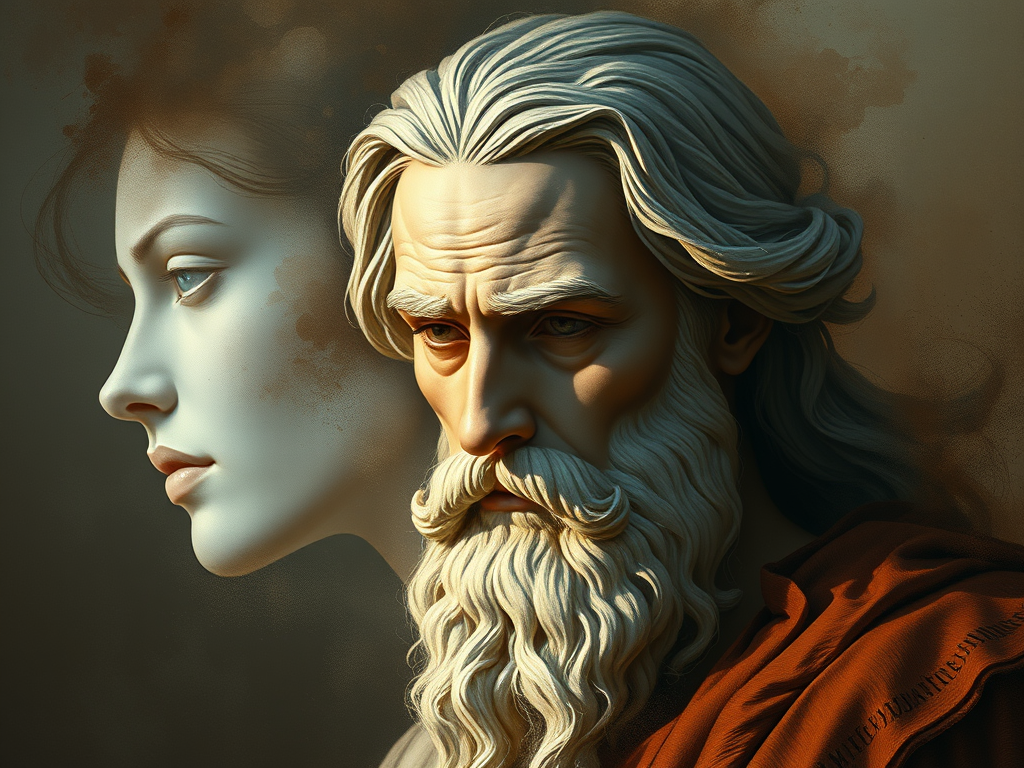
Socrates and the Silenced Feminine
How the Philosopher’s Death Symbolized the Rejection of Inner Wisdom
“You can blaspheme the Father. You can blaspheme the Son. But do not blaspheme the Holy Spirit.”
— Jesus, Gospel of Matthew
And what is the Holy Spirit, if not the silent wisdom within, the feminine voice we’ve long ignored?
Socrates was executed for “corrupting the youth” and “introducing strange gods.” But beneath the politics and public fear, something deeper was unfolding.
He was condemned for teaching a way of being that Athens—and perhaps the world—wasn’t ready to receive.
A way that was:
- Inward, not outward
- Silent, not argumentative
- Guided by conscience, not conformity
- Rooted in inner wisdom, not external rule
These are not masculine ideals in the ancient sense. They’re the traits of the feminine principle… intuition, soul, receptivity, and moral presence.
Socrates didn’t just die because he questioned the state.
He died because he embodied a feminine mode of knowing that society had no place for.
The Goddesses Were There, But Not Heard
Ancient Greece had goddesses, Athena, Aphrodite, Artemis, but they served very particular roles:
- Athena was wisdom through war and strategy
- Aphrodite was sensuality and fertility
- Artemis was wild and untamed
They were archetypes, not realities. Powerful, yes, but detached from the lived experience of inner, moral, contemplative wisdom that we might associate with the soul, the spirit, or Sophia.
Nowhere in Athens did the goddess represent what Socrates stood for:
- Dialogue over domination
- The unseen over the seen
- Conscience over compliance
- Inner voice over public acclaim
Socrates as a Carrier of the Feminine Flame
“I resemble my mother, who was a midwife… but my art is of the soul.”
~ Socrates, Theaetetus
In describing himself as a midwife, Socrates placed his philosophical method inside the most sacred, feminine framework possible: birth. He didn’t claim to create wisdom. He helped others deliver it from within themselves.
He taught through questions, not answers.
He listened more than he spoke.
He followed his intuition, not tradition.
He invoked the teachings of Diotima, a woman, as the basis for his deepest metaphysics.
In every way, Socrates was a philosopher of the inward feminine.
And his death was more than an execution; it was a silencing.
The Holy Spirit as the Mother We Forgot
The Christian scriptures contain a cryptic line, one Socrates would have understood:
“You may blaspheme the Father and the Son, but not the Holy Spirit.”
— Matthew 12:31
Why?
Because the Holy Spirit is not a figure of power. She is not seated on a throne.
She is the breath, the whisper, the conscience—the feminine presence within.
She is the Sophia of Proverbs, the Ruach of Genesis, the intuition of Socrates.
And for two thousand years, we’ve dishonored her by denying her name, silencing her presence, and labeling her as he.
Socrates didn’t make that mistake. He honored her.
And for that, he died.
A Death That Still Speaks
Socrates’ death is a warning, but also a prophecy.
We silence the feminine at great cost.
We dismiss intuition, grace, silence, and soul and build civilizations on conquest, hierarchy, and fear.
But the soul doesn’t die. The feminine doesn’t.
She waits in silent philosophers.
She waits in quiet minds.
She waits in the womb of every thinker who dares to listen instead of speak. And now, perhaps, she speaks again—through you.
Thoughts?
Let’s philosophize!
Discover more from The Silent Philosopher
Subscribe to get the latest posts sent to your email.
 The Silent Philosopher