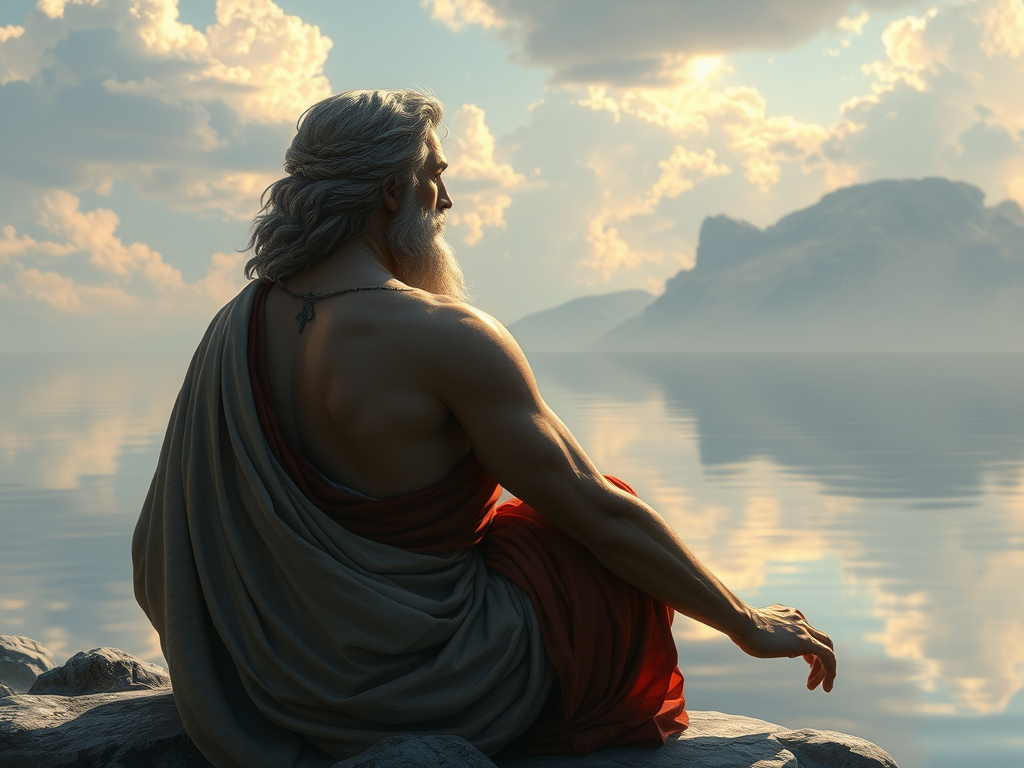
Before Socrates, Before Plato, There Was Thales, and the Question: What Is This World Made Of?
He didn’t come with scriptures.
He didn’t speak of gods in the way poets did.
He simply looked at the world and wondered:
“What holds it all together?”
And then he said something strange, simple, and timeless:
“All is water.”
Thales of Miletus: The First to Wonder Out Loud
Thales (c. 624–546 BCE) is often called the first philosopher of the Western world. Not because no one before him asked deep questions, but because he tried to answer them with reason and observation, rather than myth.
- He studied the stars.
- He predicted a solar eclipse.
- He measured the height of the pyramids using shadows.
But above all, he looked at the world and saw unity in diversity.
“All Is Water” Was More Than Just a Scientific Guess. At first glance, his theory seems primitive. Water? Really?
But beneath this lies something contemplative, even mystical…
Water shapes, sustains, and surrounds all life.
It takes the form of whatever holds it.
It flows through rock, becomes mist, and turns to ice.
It’s both gentle and powerful, visible and invisible.
All is water isn’t just material speculation, it’s symbolic philosophy.
It’s the first hint that the universe is not chaotic, but coherent and alive.
“Everything is full of gods,” Thales also said.
Meaning: consciousness, divinity, or animating spirit fills all things.
He didn’t separate science from soul — he saw through both.
Thales and the Feminine Element
It’s no coincidence that water is one of the most ancient symbols of femininity across cultures.
- In the womb, water, life begins.
- In myth, goddesses rule the sea.
- In psychology, water represents the unconscious, the intuitive, and the emotional realm.
So, in choosing water as the root of being, Thales crowned the feminine element as the origin of all things.
It wasn’t fire, stone, or sky.
It was the gentle, flowing, nourishing, yet powerful beyond measure principle.
And so hidden in the earliest roots of philosophy is the feminine wisdom later silenced.
Thales may be the first philosopher, but Sophia, wisdom herself, is the first to speak.
Thales and Meditation
Though he wasn’t a mystic in the Eastern sense, Thales’ legacy invites contemplation.
Legend says he once fell into a well while stargazing.
The irony? It’s what he most wanted to understand.
His was a philosophy of quiet wonder, a reminder that observation itself can be a form of prayer.
Why Thales Still Matters
He was the first to suggest that:
- The universe is knowable.
- Truth can be found in nature.
- Behind the many is the one.
In many ways, Thales opened the door to both science and philosophy,
but he did it without closing the door to the soul. And in water, he saw something eternal.
Discover more from The Silent Philosopher
Subscribe to get the latest posts sent to your email.
 The Silent Philosopher