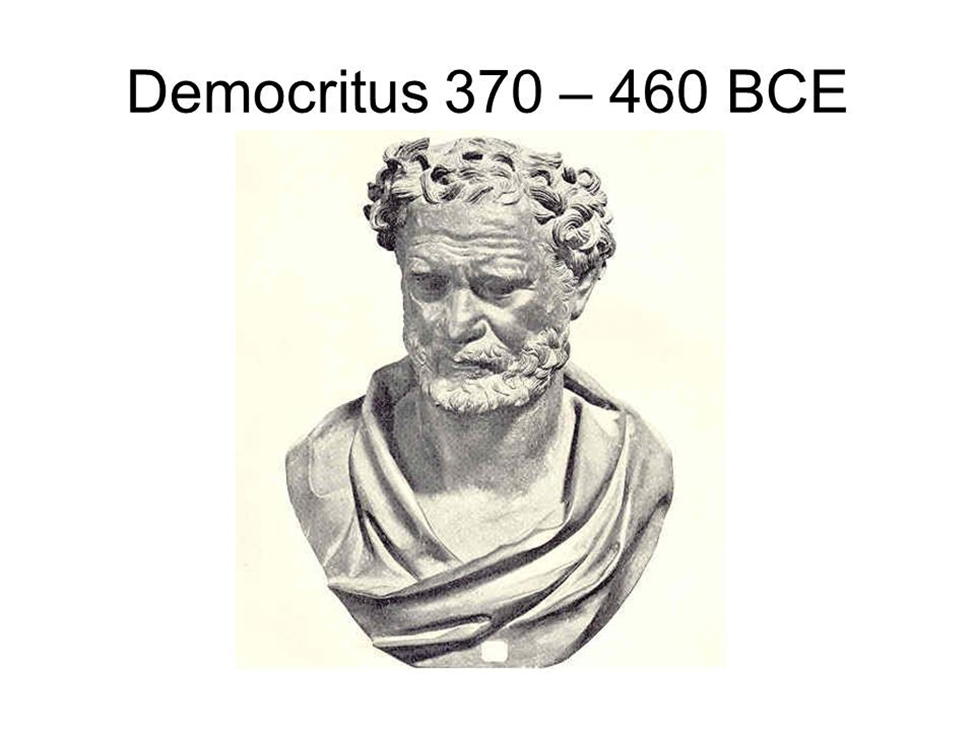
“Happiness resides not in possessions, and not in gold, happiness dwells in the soul.”
~~ Democritus
Your time machine has landed. You look at the digital control panel. It reads 410 B.C. You step out of the time pod onto the rooftop of an Ancient Greek building with Dorian-order columns. You walk to the edge and look down. There’s a courtyard with a bearded man at the center surrounded by more bearded men dressed in simple white Chitons and open-toed sandals. They all have these pondering looks upon their faces as they listen intently, yet skeptically, to the man in the center:
“Good day, my fellow kinsmen. I go by Democritus. Be wise.”
The bearded guys are all looking at each other a bit perplexed and nodding, yet all Democritus said was “Be wise.” It gets even better though. Watch…
“Men should strive to think much and know little. For what I have learned came from my greatest teacher, Leucippus. For Leucippus taught me that there is an infinite, imperceptible number of what Leucippus called atoms.”
One of the men bellows out from the crowd:
“Indivisibles! What nonsense is this that you speak of?”
Just in case you’re not aware, the word “Atom” is the Greek word for Indivisible. Sorry to interrupt.
Democritus responds:
“My fellow kinsmen, this is no-nonsense” (he wasn’t talking about the pantyhose either – they weren’t invented yet). “The nature of things consists of an infinite number of extremely small particles that cannot be conceived with the naked eye. Yet they exist and are called atoms. Atoms are physically but not geometrically indivisible. They are indestructible and completely full, containing no empty space. Because of their indestructibility, atoms are eternal. The notion of the atom itself is an ‘eternal oneness’ of the many small particles.”
Look at the people’s faces! They’re totally confused and think he’s nuts. It’s okay, though. They’re Greeks, and so they love to think and argue.
(Excerpt from my novel: God with a Blog?!)
So let’s get to the theme of this post’s topic: What is the difference between subjective and objective truth? How does that relate to the Ancient Greek scene of the philosopher Democritus above?
SUBJECTIVE TRUTH:
In 2025, atoms are an objective truth. With the proper tools, such as microscopes and all the technology we’ve discovered thus far, we know as fact – meaning objective, observable truth – that atoms exist.
But what about Democritus? They didn’t have microscopes. All they had was philosophy, which derived from contemplative meditation.
I mean, this guy, 2,427 years ago, hit the nail on the head, didn’t he? Yet, his truth was not objective – meaning observable – it was subjective. He told his truth to these people who couldn’t see it.
This was his truth bubble; theirs just wasn’t expanded yet because people tend to believe what they see more than what they hear.
It’s amazing really, no microscopes, no high-tech equipment – just “thoughts,” nothing to “show” them that everything is actually made up of what they termed “atoms.”
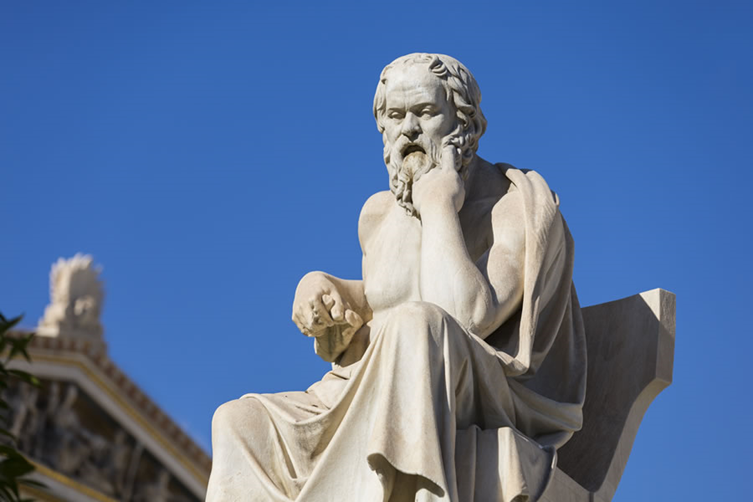
The funny thing is, Democritus is known as a pre-Socratic philosopher of Ancient Greece, which simply means before Socrates. The statue in the picture above is Socrates – the man we call the father of philosophy in our Western world. And even more astounding is that Socrates did not believe Democritus because it was a subjective truth.
As you probably know, subjective means your personal truth. Something you may have experienced through introspection or personal experience, but you can’t show it objectively to someone to prove it.
OBJECTIVE TRUTH:
Then, of course, subjective’s antonym or opposite is objective, which means not influenced by personal feelings, interpretations, or prejudice, but based upon facts – unbiased observable facts.

Interestingly, Plato, Socrates’ student, and even more importantly, Aristotle, Plato’s student, did not believe Democritus either about his theory on atoms.
In fact, it is Aristotle who came up with the Scientific Method, which is used to obtain observable, unbiased facts, in other words, “objective truths.”
So the point is, we put so much weight into observable truths, yet, it’s been proven time and time again that introspection, meditation, and going within is where absolute truth really lies.
Just look at what Einstein accomplished. He was another one who used contemplative meditation to come up with his greatest discovery, E=mc². That’s why he is often quoted as saying, “Imagination is more important than knowledge.”
And my favorite Einstein quote…
“The intuitive mind is a sacred gift and the rational mind is a faithful servant. We have created a society that honors the servant and has forgotten the gift.”
So subjective truths are still truths, but cannot be seen yet, like Democritus’ atoms and Einstein’s atoms. Yet, they became observable subject truths.
And that’s one of the sole reasons we have what I’ve termed truth bubbles versus ultimate and absolute truth.
In a world full of lies – and an economic system built on greed – we, humanity, need to understand the concept of truth.
We need to expose the lies that have been told for centuries. They need to be brought to the forefront, and we can’t evolve and expand to create world peace without this understanding and especially without the conversation.
So let’s work together:
What subjective truth does your truth bubble contain to help expand our truth bubbles? In other words, what truth do you know that can’t be observed with the naked eye, yet you know as fact that it is true?
Here’s a Joke for you on observation:
Sherlock Holmes and Dr Watson are on a camping trip.
In the middle of the night, Holmes nudges Watson awake and says, “Watson, look up at the sky and tell me what you see.”
“I see millions of stars, my dear Holmes.”
“And what do you infer from these stars?”
“Well, a number of things,” he says, lighting his pipe:
“Astronomically, I observe that there are millions of galaxies and billions of stars and planets.
“Astrologically, I observe that Saturn is in Leo.
“Horologically, I deduce that the time is approximately a quarter past three.
“Meteorologically, I expect that the weather will be fine and clear.
“Theologically, I see that God is all-powerful, and man, his creation, small and insignificant.
“What about you, Holmes?”
“Watson, you fool. Someone has stolen our tent!”
Yours truly, the Silent Philosopher
Discover more from The Silent Philosopher
Subscribe to get the latest posts sent to your email.
 The Silent Philosopher
A very interesting post, well written. Thank you for sharing this. Kind regards, Jay😊
Thanks so much, Jay.